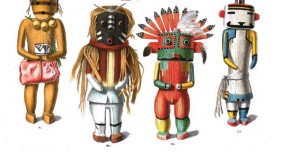
The most important aspect of Hopi Kachina doll history is that Hopi wisdom is not passed down through writing but through Kachina dolls.
About Hopi Kachina Doll History
The Hopi recognize that the sun, a cloud, a rainbow, a rock, an eagle, water, corn and more are gifts from the Creator. Hopi Kachina doll history teaches the importance of these relationships. The dolls represent specific qualities that help in living a better life.The holy spirits, or Kachinas, come from the San Francisco hills and peaks to help the Hopi survive. They represent rain for a rich harvest, health for a long life and fertility. The harmony with nature is honored and balance is achieved.
The arrival of the Kachinas begins with the winter solstice. Their arrival is welcomed and celebrated. Men descend into ceremonial rooms underground called kivas. The men of particular clans partly merge with the Kachinas by wearing the clothes, colors, masks and items. The men personify both male and female holy spirits. A ceremony is held before the men ascend from the kiva.
Above ground, traditional dancing and songs are performed. Spectators offer prayers and sprinkle corn pollen on the Kachinas. This action represents a circle of give and take, of maintaining harmony and balance between the Hopi and the spirits.
Ceremonies continue through the planting of seeds, and the crops mature. Then, as Hopi Kachina doll history says, the Kachinas go back to their homes in the San Francisco hills and peaks.
Hopi Kachina doll history teaches us that dolls are made by men. They are distributed between dances to female children. They are given during the Spring Bean Planting ceremony and the summer Home Dance ceremony. Male children receive toy bows and arrows. Sweets, fruit and rattles are also distributed to the children.
The Kachina dolls symbolize the important relationship between the Hopi and the environment. According to Hopi Kachina doll history, the dolls are made from cottonwood roots. The dolls are not a toy, but the means of educating children and passing on the culture. The symbolism, stories and blessings associated with the Kachina is passed from generation to generation. There may be up to 300 diverse Kachina dolls.
The Kachina dolls are made with unsurpassed care and skill. The proper cottonwood must be found. A special clay is applied to season the cottonwood. The artist uses involved techniques and properly made paints and accessories. Although society has altered the process of creating a Kachina doll, principally in paints, the transmission of the meanings are intact.
Through their anchor to the past and honoring the give and take of the environment represented by Kachina dolls, the Hopi share wisdom that they hope can benefit the world.